

How Florida’s Homeowners’ Insurance Market is Rebounding: Legislative Reform, Actuarial Insight, and a Path Forward
- Florida’s homeowners insurance market is showing significant signs of recovery following nearly a decade of instability, driven largely by legislative reforms enacted in 2022 to address litigation abuse, rising claims costs and insurer financial challenges.
- Legislative changes have helped stabilize the market, improve underwriting results, attract new capital and restore confidence among insurers and reinsurers. Florida's combined homeowners insurance ratio improved substantially between 2022 and 2025.
- Pinnacle Principal and Consulting Actuary Art Randolph discusses how actuarial analysis, evolving reserving methodologies and real-time claims monitoring helped insurers navigate Florida's challenging insurance environment.
- Florida's experience offers important lessons for insurers in other states facing similar challenges, highlighting the value of proactive actuarial oversight, data analytics, and early identification of emerging claims trends.
After nearly a decade of instability, Florida's homeowners insurance market is showing signs of recovery. Here's what carriers in other states can learn from the turnaround.
Few property insurance markets in the United States have endured as much turbulence over the past decade as Florida's. Between 2017 and 2024, 10 carriers became insolvent outright, with an estimated 10 more disappearing through what industry observers call "shadow insolvencies" — consolidations within holding company families where financially distressed carriers were absorbed to keep a single entity afloat or where companies executed a controlled runoff.
The crisis was so severe that homeowners’ premiums began consuming approximately 10% of household income for many Floridians, and when combined with the state's elevated auto rates, total insurance costs reached almost 15% of household budgets. Reinsurers walked away from the table. Capital became scarce and expensive. And consumers, carriers, and legislators alike were left searching for answers.
"What largely plagued the Florida homeowners market surrounded the assignment of benefits issue — or abuse, depending on who was asked — and how that evolved over time," said Art Randolph, Principal and Consulting Actuary at Pinnacle Actuarial Resources.
How a Legal Loophole Unraveled a Market
The assignment of benefits (AOB) mechanism allowed policyholders to turn over their insurance benefits to third parties — typically water remediation companies, roofers, or other contractors who served as "first responders" to a loss. What began as a convenience for homeowners quickly metastasized into something far more damaging once Florida's plaintiff's bar entered the picture.
Fueling the crisis was Florida's one-way attorney fee statute. If a court found that an insurer had underpaid a claim by even a dollar, the carrier was required to pay all of the insured's attorney fees — often with a multiplier attached. From there, bad faith allegations frequently followed.
"When attorneys got involved, things often cascaded into a litany of bad faith and higher-severity claims," Randolph said.
The numbers tell the story. According to National Association of Insurance Commissioners (NAIC) data, Florida represented roughly 10% of U.S. homeowners claims from 2016 through 2023 — roughly proportional to its share of the national population. But Florida accounted for approximately 73% of all litigated homeowners claims in the country during this same period.
Claim severity ballooned as well. A routine burst pipe claim from a washing machine, which historically ran $3,000 to $5,000, began landing closer to $17,000 to $20,000 on the indemnity side alone. Defense cost containment expense ratios in Florida climbed to over 9% at their peak in 2022, compared to a national average of 1 to 2%. And the marketing muscle of plaintiff's attorneys — billboards urging drivers to call lawyers before their own insurer — overwhelmed carriers' ability to educate consumers.
Then, in 2022, Hurricane Ian struck. "By the time Ian came through in 2022, a lot of companies were thinly capitalized," Randolph said.
Reform Delivers Immediate Results
Florida's legislative reforms, enacted at year-end 2022 and effective January 1, 2023, were designed to address affordability, stabilize the market, restore confidence among reinsurers and capital providers, and encourage new company formations.
Unlike reforms in other lines — such as medical professional liability, where impact can take years to quantify — Florida's homeowners reforms produced immediate results.
"These carriers had operating ratios that consistently ran over 100% year after year as a consolidated group," Randolph said. "As a combined cohort for the last five years, these companies were hemorrhaging cash."
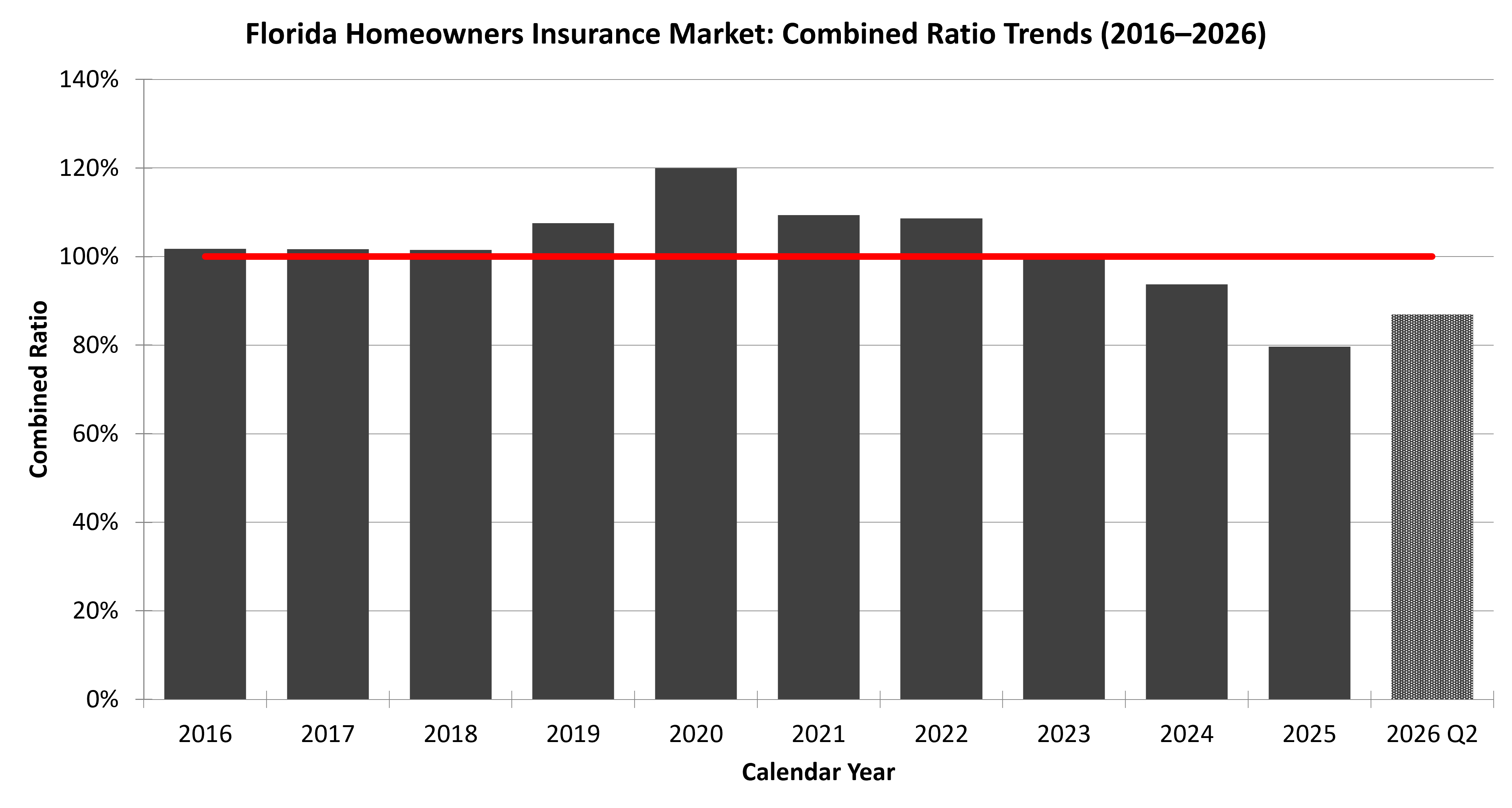
Then came the turnaround. In the year the reforms were implemented, there was a significant reduction in the calendar year loss and loss adjustment expense ratio, and the cohort did not suffer a measurable net loss for the first time in five years. By calendar year-end 2025, the combined cohort's operating ratio had fallen to 75% — a 33-point improvement from year-end 2022 before the reforms. The combined ratio dropped from roughly 109% to 80% during the same period.
"A 29 percentage point drop in combined ratio in three years is a rather precipitous drop," Randolph said.
New capital has followed. Beginning in 2021, 21 new property companies have formed in Florida — evidence that reinsurers, investors, and management teams are regaining confidence in the state's market.
But Randolph cautioned that the problems haven't disappeared — they've migrated. "When Florida shut down some of these bad actors, they essentially rolled up shop and drove I-10 West to Louisiana and Texas," he said. Both states are now contemplating their own sets of reforms as they confront creative plaintiff's bars, aggressive trades, and door-knocking contractors.
Where Actuarial Insight Makes a Difference
For carriers operating in Florida or exposed to similar dynamics in neighboring states, Randolph argues that the lessons of the past decade point to one critical imperative: real-time data analytics and anomaly monitoring.
"These companies were seeing homeowners’ claims being reported later than they normally would," Randolph said. "Claims that would normally come in within two to three weeks were now coming in two to three months, and the first notices of loss were being presented through attorneys rather than policyholders. That should have rung all kinds of alarm bells."
Traditionally, actuarial rate reviews occur once a year and reserve analyses once or twice annually. But things have changed.
"With the quality and accessibility of real-time data available today, there's no need to wait for an actuary to tell you six months after an issue has already manifested that you have a problem," Randolph said. "Companies, underwriters, and claims professionals should have dashboards that can alert them to issues like this in real time."
The dashboards don't need to be elaborate. Power BI–style tools can track protracted claim reporting, flag claims first represented by attorneys, surface fraud indicators, and route certain claims to specialized triage — allowing management teams to intervene early rather than letting problem patterns fester.
As a firm serving carriers through the Florida crisis, Pinnacle Actuarial Resources adapted its methodologies to help clients make better-informed reserving decisions when historical data could no longer be trusted as a predictor.
"Because homeowners policies are on an occurrence trigger, we tried to isolate the claims in a way that would help company management make more informed decisions about the adequacy of their reserves, even during the height of the crisis." Randolph said. In practice, that meant converting accident year analyses into report year analyses plus a tail — an effort to estimate how many unreported claims remained in the pipeline and what their likely severity would be.
"We realized a fair amount of success with that approach," Randolph said. "However, what was going on in Florida was an evolving pattern of abuse. The strategies of the plaintiff's bar and the trades continued to evolve such that typical actuarial methodology just could not keep pace."
That reality underscores the broader lesson: carriers that combine strong actuarial partnerships with real-time monitoring of claim dynamics are best positioned to recognize emerging threats and respond before they erode underwriting results.
Florida's reforms are proof that market dislocations can be reversed when legislators, regulators, carriers, and actuaries work together. For insurers writing in states where similar pressures are building, the time to act is before the next crisis takes hold.
(published in Insights by Risk & Insurance)
News & Insights

California’s Homeowners Insurance Crisis Is About More Than Affordability

Ratemaking with Dynamic Data

Why Actuarial Pricing Discipline Matters in Captive Insurance — and How to Strengthen the Partnership
